

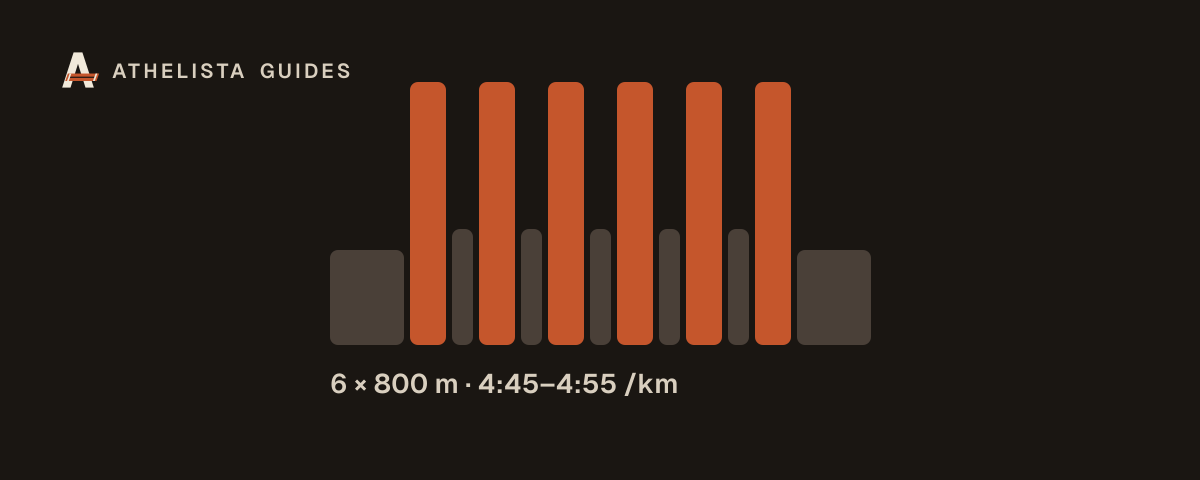

The most common interval session goes like this: the first rep is well under the target, the middle ones are about right, and the last two are a struggle. The average pace looks fine. The session still missed its point.
This guide is for runners and coaches who want reps that land where they were planned. It covers what a target pace range is for, how much leeway to give it, how to record the session so each rep can be checked, and how to read a group's session without opening every runner's watch data.
A target is a range, not a number
"6 × 800 m at 4:05–4:15 per km" is easier to hit well than "6 × 800 m at 4:10". A range allows for a slightly uphill stretch, a gust of wind or a crowded path, and still asks for the same effort.
Choose the range from what the session is for:
| Session | Typical target | What it trains |
|---|---|---|
| Long reps (1–2 km) | 10K pace | Holding a hard, steady effort |
| Medium reps (600–1000 m) | 5K pace | Speed you can sustain for a race |
| Short reps (200–400 m) | Mile pace or a little faster | Speed and form |
If you don't know your race paces, the free pace calculator works them out from a recent race.
Why "too fast" is a problem
Running a rep faster than planned feels like a good day. It usually isn't:
- It changes the session. 800 m reps planned at 5K pace and run at 3K pace train something else, and need more recovery than the plan gives.
- The last reps pay for it. Most fading sessions start too fast, not too slow.
- In a group, it spreads. One runner who goes off fast pulls the people around them over their own target.
- It adds up. Week after week of "a bit quicker than planned" is how tired legs and niggles start.
So treat a rep that was too fast as a caution, not a win. The aim is even reps inside the range.
Give the target a little leeway
GPS on a watch isn't perfect, especially on short reps near buildings, under trees or on a bendy path. A rep that's 1–2 seconds per km outside the range is usually measurement noise, not a pacing mistake.
A sensible rule is ±2 seconds per km (about ±3 seconds per mile) counts as on target. On a track, where the distance is exact, you can be stricter. For hilly or trail reps, judge by effort and heart rate as well as pace.
Get one lap per rep
You can only check reps if the watch records each one as its own lap. Auto-lap every kilometre or mile mixes reps and recoveries together and makes the session unreadable.
Two ways to get clean laps:
- Send the workout to the watch. A structured workout (warm-up, 6 × 800 m, 400 m jog, cool-down) starts each step for you, so every rep and every recovery is its own lap. See how to send structured workouts to Garmin watches.
- Press the lap button at the start and end of each rep. It works, but it's easy to forget one when you're tired.
Read the session rep by rep
Here's a 6 × 800 m session with a target of 4:05–4:15 per km and ±2 s of leeway:
| Rep | Pace (per km) | Against the target |
|---|---|---|
| 1 | 4:00 | ▲ 5 s too fast |
| 2 | 4:07 | ✓ on target |
| 3 | 4:10 | ✓ on target |
| 4 | 4:13 | ✓ on target |
| 5 | 4:19 | ▼ 4 s too slow |
| 6 | 4:26 | ▼ 11 s too slow |
The average is 4:12, right in the range. But the shape tells the real story: a fast first rep and a fade at the end. Next time, the fix isn't "run faster on reps 5 and 6". It's "start rep 1 at 4:12 and hold it".
Three patterns to look for:
- Fast start, slow finish: start more slowly. This is the most common one.
- Even but all slow: the target may be too ambitious for now, or the runner was tired. Check their heart rate and how they said they felt.
- Even pace, rising heart rate: normal at the end of a hard session; worrying if it happens on rep 2.
Coaching a group: everyone against their own target
In a run club, people run the same session at different paces. Comparing runner A's 3:50 with runner B's 4:40 tells you nothing. What matters is how each runner did against their own target.
Give each pace group its own targets ("5K pace" means something different for each group), then read the session as one row per runner:
- The whole group too fast on rep 1? That's the start, not the runners. Say it at the start line next time.
- One runner too slow on every rep, week after week? Their target is probably too ambitious. Move them to a slower group.
- One runner too fast on every rep? They may be ready for the next group up, or racing the session.
- Reps missing for someone? Their watch may not have recorded laps. Check that the workout was sent to it.
Reading forty runners' watch screenshots in a group chat doesn't work. One row per runner against their own target takes a minute.
How Athelista shows this
Athelista draws every run's laps as a bar chart: wider bars are longer laps, taller bars are faster ones. Each rep carries a dashed band for the athlete's own target, marked ✓ on target, ▲ too fast, ▼ too slow and ★ for the fastest rep.
- Coaches see the whole batch's session in one view, one row per athlete against their own target, sorted by who was most on target.
- Leeway is a coach setting: exact, ±2 s per km or ±5 s per km.
- Pace groups give each runner their own targets from one workout, on the app and on their watch.
Read more about laps and the lap chart and pace groups.
Coaching a club? Start free with up to 3 athletes.